
Beyond Transpacific: Intra-Asia Shipping in 2026
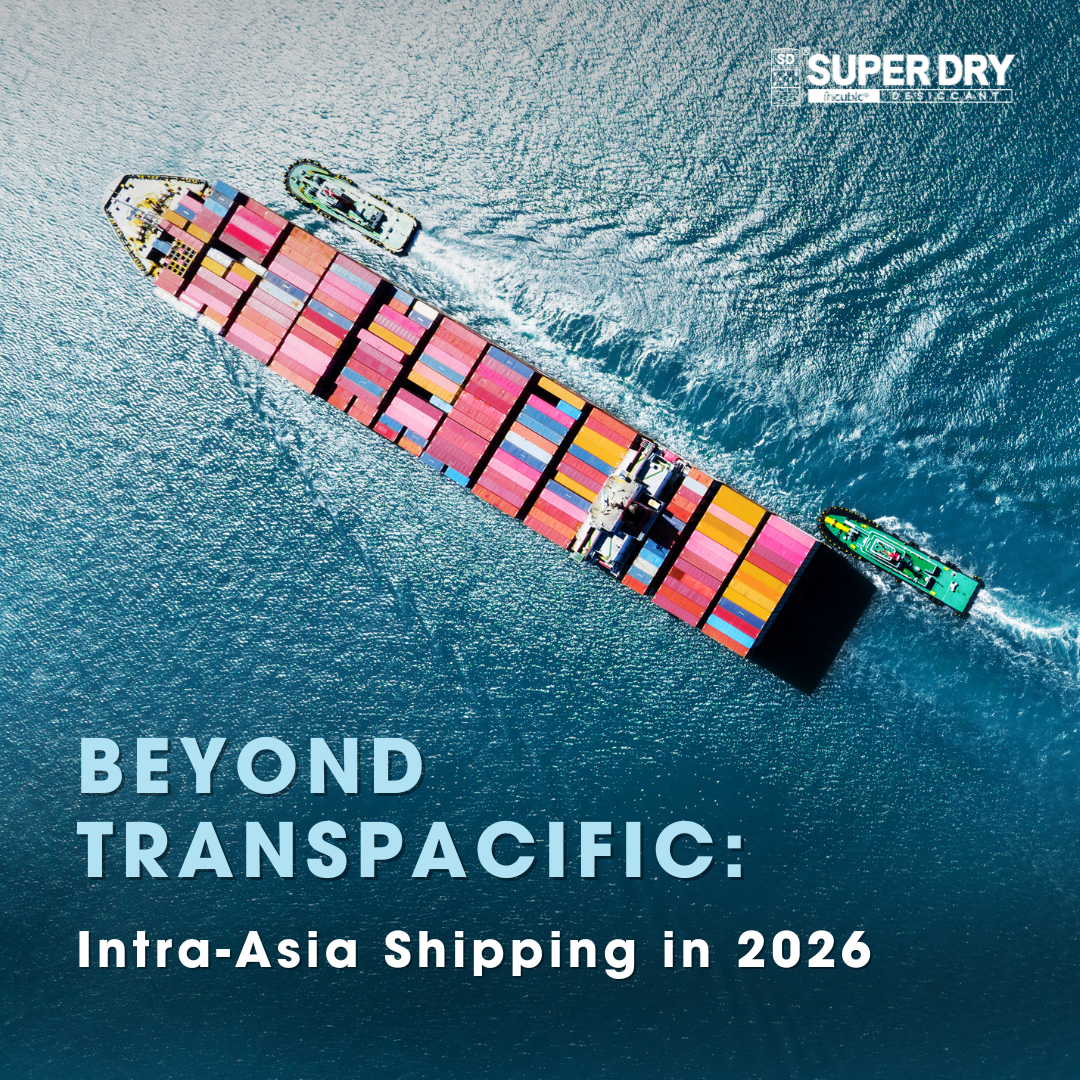
Yang Ming Marine Transport Corporation announced this week that it will launch a new China-Singapore-Malaysia (CSM) service starting April 3, 2026. Three vessels of approximately 2,800 TEU will operate a fixed weekly schedule on a 21-day rotation connecting Xiamen, Kaohsiung, Shekou, Singapore, and Port Kelang.
It is the latest in a growing wave of intra-Asia service launches. And it points to something bigger than one carrier expanding one route.
Intra-Asia Is Now the World’s Largest Container Trade
Intra-Asia trade surpassed every other container trade lane in 2025, growing 5% year-on-year to become the single largest corridor by volume, more than double the size of the Far East to North America route. The drivers are structural rather than seasonal. The ongoing shift of manufacturing from China into Vietnam, Thailand, Malaysia, and Indonesia has created a dense web of raw material flows, semi-finished goods transfers, and finished product movements between South China and Southeast Asia.
Intra-regional trade now accounts for more than half of Asia’s total trade, and the International Monetary Fund projects that intra-Asian trade will constitute approximately 40% of global trade by 2030. Total intra-Asian container capacity surged 12.8% year-on-year to nearly 2.4 million TEU as of mid-2025, with every major carrier expanding its regional footprint.
The Moisture Problem Hiding in the Busiest Trade Lane
The South China to Southeast Asia corridor runs through some of the most consistently hot and humid conditions on any ocean shipping route. Average relative humidity across this region hovers between 75% and 85% year-round, and temperatures regularly exceed 30 degrees Celsius at port. Containers loaded in Shekou or Xiamen and discharged in Singapore or Port Kelang are exposed to tropical conditions from departure to arrival, with minimal temperature variation to allow moisture levels inside the container to drop.
This matters because moisture damage does not require container rain or visible condensation to begin. Mold activation starts at approximately 65% relative humidity. Corrosion on metal parts and fittings can initiate at similar levels.
The cargo moving on these routes reflects the region’s manufacturing profile: garments and textiles, leather goods, footwear, wooden furniture, electronics, and consumer products. Many of these categories are hygroscopic, meaning they absorb and hold moisture from the surrounding air.
Shorter Voyages Do Not Mean Lower Risk
There is a common assumption that intra-Asia shipments, because they are shorter than intercontinental voyages, carry less moisture risk. The opposite can be true. Shorter voyages in tropical conditions mean the cargo is exposed to consistently high humidity for the entire transit without the temperature drops that occur on longer routes crossing into temperate zones. There is no natural drying cycle. The container environment stays warm and wet from origin to destination.
Port congestion across Southeast Asia adds further exposure time. Port Kelang, one of the stops on Yang Ming’s new CSM route, has been experiencing delays of up to 96 hours in recent months. Singapore, while more fluid, still has average waiting times of one to two days. Every additional hour sitting at port in tropical heat is another hour of moisture accumulation inside the container.
Choosing the Right Protection for Tropical Routes
On intra-Asia routes where humidity is high from start to finish and temperatures rarely drop below 25 degrees Celsius, the type of desiccant used to protect cargo matters significantly.
Calcium chloride-based absorbent desiccants absorbs moisture through a chemical reaction that locks it into a gel, preventing re-release even as temperatures fluctuate. With an absorption capacity of up to 300% of their dry weight and an effective range of 0 to 90 degrees Celsius, they are built for exactly the kind of sustained high-humidity environment found on South China to Southeast Asia routes.
Super Dry desiccants use this calcium chloride and starch formula, and they remain active for up to 90 days. For businesses shipping on the expanding intra-Asia network, matching the desiccant to the climate of the route is one of the simplest and most effective ways to prevent any damage before it starts.
Learn more at superdryers.com