
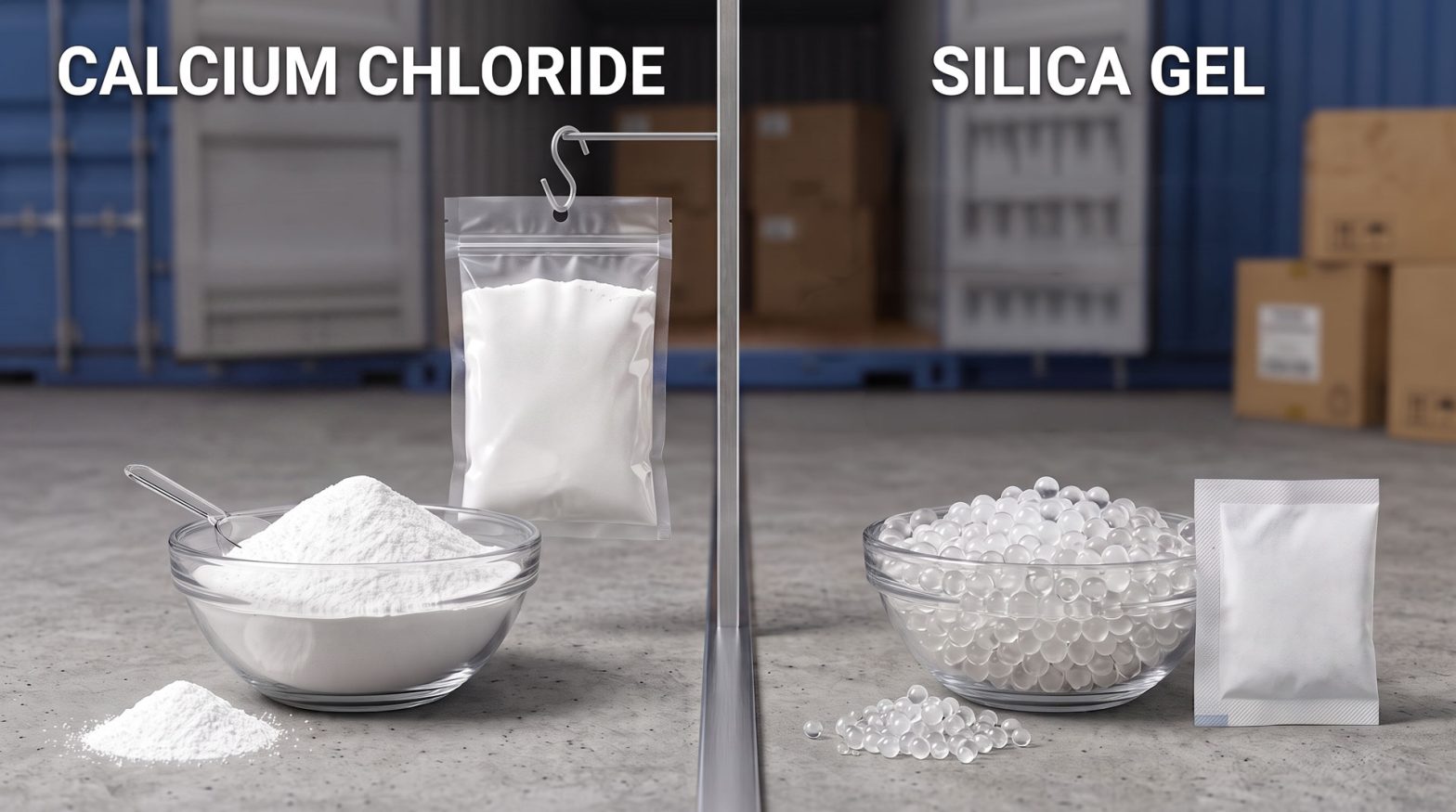
⚡ QUICK ANSWER
For sea-freight containers, calcium chloride is the better desiccant. It can absorb moisture up to about 200–300% of its own weight and keeps working across long ocean voyages, while silica gel typically absorbs only 20–30% of its weight and saturates quickly. Silica gel still suits small, sealed packaging where space is tight; calcium chloride is designed for the high-humidity, long-duration conditions inside shipping containers.
📊 KEY FIGURES
• Calcium chloride: absorbs up to ~200–300% of its own weight in moisture.
• Silica gel: absorbs roughly 20–30% of its own weight.
• A single 40ft container can accumulate several litres of condensation (“container rain”) on a long voyage.
• Ocean transit routinely swings between 20°C and 60°C+, driving repeated condensation cycles.
What is the difference between calcium chloride and silica gel?
Both are desiccants — materials that pull water vapour out of the air — but they work in fundamentally different ways, and that difference decides which one protects your cargo.
Silica gel is an adsorbent: water molecules cling to the surface of tiny pores in the gel. Once those pores fill up, it stops working and can even release moisture back if temperatures rise. Calcium chloride is an absorbent: it chemically binds water, turns it into a brine, and traps it in a gel or pouch so it cannot be released back into the container.
That single distinction — surface adsorption versus chemical absorption — is why calcium chloride holds many times more water and keeps performing through the temperature swings of an ocean voyage.
How much moisture can each desiccant absorb?
Absorption capacity is the number that matters most for containerised cargo, because a 20ft or 40ft container is a large, poorly ventilated space that generates a lot of condensation over weeks at sea.
| Property | Calcium Chloride | Silica Gel |
|---|---|---|
| Absorption capacity | Up to ~200–300% of own weight | ~20–30% of own weight |
| Mechanism | Chemical absorption (locks water in a gel) | Surface adsorption (holds water on pores) |
| Re-release risk | Very low — water is trapped as brine | Higher — can desorb when warm |
| Best environment | High humidity, long duration | Low humidity, short duration, sealed |
| Typical use | Ocean containers, large cartons | Small boxes, electronics, medicine |
General industry ranges. Exact figures vary by product formulation and ambient conditions.
Why does calcium chloride win for ocean freight?
A shipping container behaves like a sealed metal box that heats up during the day and cools at night. Warm air holds more water vapour; when the steel walls cool, that vapour condenses into droplets that drip onto cargo — a phenomenon commonly called “container rain” or “cargo sweat.”
Over a multi-week voyage this cycle repeats dozens of times, releasing far more moisture than a handful of silica gel packets can hold. Calcium chloride’s high capacity and locked-in absorption let it keep pulling that moisture down for the whole journey.
Where silica gel still makes sense
Silica gel is not obsolete. For small, individually sealed packages — electronics, pharmaceuticals, camera gear — where the enclosed air volume is tiny and transit is short, silica gel is inexpensive, non-corrosive and perfectly adequate. The mismatch only appears when it is asked to protect a whole container.
Which desiccant should you choose?
Match the desiccant to the space and the journey:
- Choose calcium chloride for containerised ocean freight, long transit times, or any cargo sensitive to mould, rust or caking (textiles, food, leather, electronics in bulk, machinery).
- Choose silica gel for small sealed retail packs, short domestic transport, or items already in low-humidity packaging.
- For most exporters shipping full containers, container-grade calcium chloride desiccants (pole, hanging, or blanket formats) are the reliable default.
Frequently Asked Questions
Is calcium chloride better than silica gel for shipping containers?
Yes. Calcium chloride absorbs up to about 200–300% of its own weight and keeps working through the temperature swings of an ocean voyage, while silica gel absorbs only around 20–30% of its weight and saturates quickly. For full containers, calcium chloride gives far more protection per gram.
Can silica gel and calcium chloride be used together?
They can, but it is rarely necessary. In a container, calcium chloride does the heavy lifting. Silica gel is better reserved for small sealed packages inside the container where an extra layer of local protection is wanted.
Does calcium chloride desiccant leak?
Quality container desiccants trap the absorbed water as a thick gel inside a leak-resistant, multi-layer pouch, so there is no free liquid to spill onto cargo. Always follow the manufacturer’s placement guidance.
How long does calcium chloride desiccant last in a container?
Container-grade calcium chloride is designed to keep absorbing for the length of a typical ocean voyage — commonly several weeks. Actual life depends on ambient humidity, temperature and how much desiccant is loaded.